Reading a Building Entrance on a Rainy Day
Reading a building entrance on a rainy day reveals how shelter, approach, thresholds, and directional cues help visitors arrive without confusion.
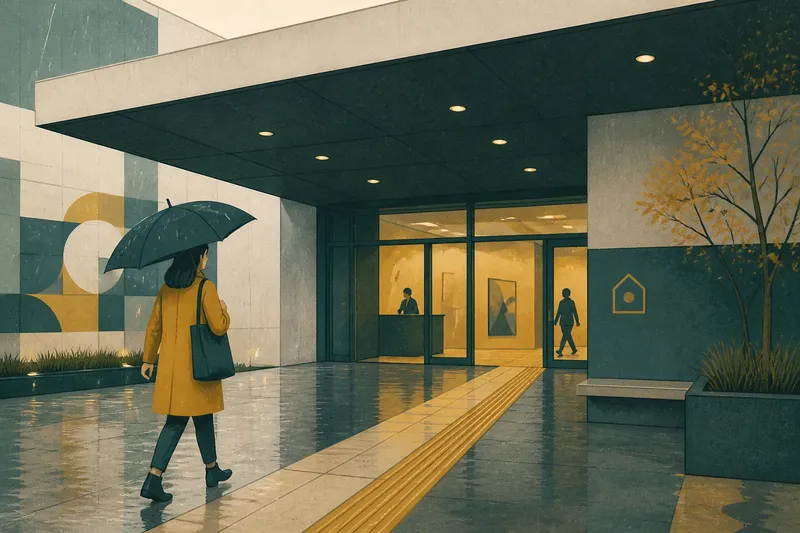
Reading a building entrance on a rainy day starts with a simple question: where can you pause without blocking someone else? Rain makes the entrance’s instructions unusually visible. A canopy, a change in paving, a mat, or a sign can show how the building expects a visitor to move from the street to the inside.
Use the weather as a way to observe, not as a reason to judge a building by one difficult moment. Stand where you are permitted to stand, notice the route people naturally take, and separate what the entrance makes clear from what you have to guess. The right interpretation depends on your situation: arriving on foot, looking for a door, waiting for someone, or trying to enter with limited mobility all expose different strengths and gaps.
What should you notice first when you arrive on foot?
If you are approaching from the sidewalk, begin with the shelter. Look for an overhang, recessed doorway, covered walkway, or nearby place to stop out of the rain. Ask whether it protects the route to the entrance or only the door itself. A canopy that shelters the threshold but leaves the approach exposed offers a different kind of welcome from a continuous covered path.
Then look at the ground. Paving may direct you toward the entrance through a change in texture, color, direction, or slope. A distinct path can help visitors identify where to walk, while a broad paved forecourt may leave several possible routes. Neither arrangement is automatically better: a clear path can be helpful, but it may lead people past a convenient place to pause or make the entry feel more formal.
Rain adds visible clues. Water may collect in a low spot, run across a walking route, or drip from a canopy edge. Notice whether the dry area lines up with the path people use. You do not need to infer how the drainage system works; simply observe where a visitor has to step, wait, or change direction to stay reasonably sheltered.
Does the entrance make the intended door easy to find?
If you have never visited before, focus on the decision points. From the sidewalk, can you tell which opening is for visitors? Does a sign become visible before you reach the doorway, or only once you are beside it? Is the main door visually prominent, or does it sit among service doors, windows, and secondary entrances that look similar?
Signs are only one kind of direction. A path that narrows toward a single door, a canopy centered over an opening, or a lobby visible through glass can also suggest where to go. These cues work together. If the sign points one way but the most direct sheltered path leads another, a first-time visitor may hesitate. That pause is useful evidence about how the entrance communicates, not proof that any one feature is badly designed.
Look for what happens at the point where a visitor must choose. A visitor entrance may be marked with a name, a reception symbol, or a clear view of a desk. If the building has separate entrances for different users, their signs and routes should help distinguish them before someone has committed to the wrong door. During a wet-weather visit, a person may be focused on staying dry and less likely to stop and study a cluster of small signs.
What does the threshold tell you about entering?
The threshold is the transition between outside and inside. It may be a door leaf, a vestibule, a change in floor material, a mat, or a slight change in level. Observe how many transitions a visitor encounters and what each seems to ask of them: pause, open a door, wait for another person, wipe wet shoes, or choose a direction.
A vestibule, sometimes called an airlock, is a small space between exterior and interior doors. In rain, it can provide a place to close one door before opening the next and to orient yourself before entering the main room. It can also become a bottleneck if people are waiting, shaking umbrellas, or trying to pass in opposite directions. Notice whether there is somewhere to stand without obstructing the route.
Floor changes and mats can mark the transition while catching water and dirt. A mat that sits firmly and does not interrupt the walking route reads differently from one that curls, shifts, or leaves a slick edge. The observation exercise is about the entrance as experienced: what changes underfoot, where people slow down, and whether the next action is apparent.
Which entrance cues matter most for your situation?
What should a first-time visitor look for?
Follow the route from the sidewalk and identify the first point where you would need to make a choice. A visible entrance sign, a legible path, and a view toward reception can reduce uncertainty. If those cues appear only at the door, the visitor may have to approach several openings before knowing which one is intended.
What matters when you are waiting for someone?
Look for a place to wait that is covered without occupying the doorway or narrowing the approach. A shallow recess or sheltered edge may offer a pause, while a busy vestibule may be better treated as a passage. Watch how the entrance accommodates people who stop briefly as well as those who keep moving.
What should someone using a mobility aid observe?
Pay attention to the continuity of the route: whether the approach is clear, the threshold appears passable, and the entrance offers a level path rather than an unexpected step. Also notice how doors open and whether people can pause without blocking one another. For an actual access decision, consult the building’s accessibility information or a qualified access professional; appearance alone cannot establish compliance.
What changes if you are carrying bags or an umbrella?
Look for a place to manage belongings before reaching the door, and notice whether the route leaves room to hold an umbrella without striking other people. A deep canopy or roomy vestibule may make arrival less awkward; a narrow, exposed approach may require visitors to coordinate their movements more carefully. The useful question is where hands and attention are needed at each transition.
How can you make the observation useful?
Choose one route and trace it in order rather than collecting disconnected impressions. Start at the edge of the public sidewalk and follow the approach to the point where you can orient yourself inside. At each transition, ask what the building tells you to do and what you would have to infer.
Say you are visiting an unfamiliar community arts building in steady rain. You see a broad canopy, but its dry strip ends before the main door; two similar doors face the plaza, and a small sign beside one names the reception entrance. You follow the sign, then find a mat and a short vestibule with a view toward the front desk. You could record that the canopy offers a place to pause, the sign resolves the door choice late in the approach, and the interior view confirms where to go. Those observations describe the visitor’s sequence without claiming what the designer intended.
If you want to make notes, keep them concrete. A sketch of the route can show where the shelter begins and ends; short phrases can record a sign’s position, a change underfoot, or a place where people pause. Avoid turning a single rainy visit into a verdict about the whole building. Weather, crowding, and temporary mats may change the experience, so describe what you actually saw and distinguish it from what you suspect.
What should you avoid assuming from one wet visit?
Do not treat a puddle or a crowded vestibule as a complete diagnosis. Rain can reveal where water is visible and how people adapt, but a brief observation cannot explain drainage, maintenance, or the building’s full range of access arrangements. Focus on the decisions a visitor faces rather than guessing at hidden causes.
It is also easy to mistake a formal entrance for a confusing one, or a modest doorway for an unwelcoming one. A clear route can be quiet and understated; a prominent canopy can still leave the visitor unsure where to go. Judge cues by the work they do in sequence: locating the entrance, reaching it, crossing the threshold, and orienting inside.
Reading a building entrance on a rainy day is most useful when you follow one visitor’s path and notice where the building gives a cue, offers a pause, or leaves a choice unresolved. That sequence gives you a practical way to compare entrances without needing a floor plan: start where the visitor begins, and stop when the next destination is clear.